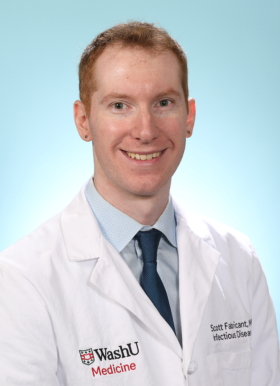
Scott Fabricant, MD, PhD
Assistant Professor of Medicine
- Email: fabricant@nospam.wustl.edu
Dr. Fabricant attends on the inpatient ID consult service at BJH. He runs a general clinic and also works with our HCV and STI programs.
Dr. Scott Fabricant joined WashU Medicine Division of Infectious Diseases as an Assistant Professor of Medicine in August 2026. Dr. Fabricant received his medical degree from Rutgers New Jersey Medical School and completed his residency in internal medicine at New York Presbyterian Hospital before going on to serve as an ID fellow at Boston Medical Center (Boston University). Prior to medical school, Dr. Fabricant majored in biology at Washington University and then completed a PhD in evolutionary ecology at Macquarie University in Sydney, Australia. He then traveled to Brazil for a postdoctoral fellowship studying immunity to mycoses.
Dr. Fabricant’s clinical and research interests focus on the intersection of infectious diseases and substance use disorders, including serious injection-related infections, hepatitis C, HIV prevention, and evidence-based risk reduction strategies. He also has a strong interest in the prevention, diagnosis, and treatment of sexually transmitted infections. Dr. Fabricant is passionate about medical education and enjoys working with learners at all stages of training, with a particular focus on curriculum development for medical students.
Dr. Fabricant works primarily on the inpatient ID consult service at BJH while also running a general and post-discharge infectious diseases clinic. He also will be working with the WashU Medicine HCV and sexually transmitted infections programs.

Infectious Diseases Clinic
- Physical Address: 620 South Taylor Avenue, St. Louis, MO, United States
-
Mailing Address:
620 South Taylor Ave., Suite 100
St. Louis, MO 63110
- BS: Biology: Washington University in St. Louis, St. Louis MO (2009)
- PhD: Evolutionary Ecology: Macquarie University in Sydney, Australia (2014)
- Postdoctoral fellowship: Catholic University of Brasilia, Districto Federal, Brazil (2015)
- MD: Rutgers New Jersey Medical School, Newark NJ (2021)
- Internal Medicine Residency: New York Presbyterian Hospital, New York NY (2024)
- Infectious Diseases fellowship: Boston Medical Center (Boston University), Boston MA (2026)
- Maxwell Finland award for research in fellowship, Massachusetts Infectious Disease Society (2026)
- Infectious Disease Society of America, trainee member (2025)
- American Board of Internal Medicine
- Fabricant SA, Abramson EH, Hutchings K, Vien A, Scherer S, Kapadia S (2024) PICC Your Poison: Resident Beliefs and Attitudes Regarding Discharge Parenteral Antibiotics for Patients Who Inject Drugs, Open Forum Infectious Diseases, 11(7). DOI: 10.1093/ofid/ofae364
- Ramdin C, Guo M, Fabricant SA, Santos C, Nelson L. The Impact of a Peer-Navigator Program on Naloxone Distribution and Buprenorphine Utilization in the Emergency Department. Subst Use Misuse. 2022;57(4):581-587. doi: 10.1080/10826084.2021.2023187. Epub 2021 Dec 31. PMID: 34970942.
- Fabricant SA, Yang A, Ooms A, Boos D, Oettinger J, Traba C. Coming Together: How Medical Students, Academic Administrators, and Hospital Administrators Approached Student Volunteering During the COVID-19 Pandemic. Med Sci Educ. 2021 May 19;31(4):1539-1544. doi: 10.1007/s40670-021-01315-w. PMID: 34026308; PMCID: PMC8132734.
- de Oliveira Júnior GP, de Sousa HR, Gorgonha KCM, Tomaz LLM, Borges TKDS, Rangel KT, Fabricant SA, Koser Gustafson F, Albuquerque LF, Rossi Neto A, Hurtado FA, Paes HC, Casadevall A, Silva-Pereira I, Felipe MSS, Albuquerque P, Nicola AM. LC3-associated phagocytosis in macrophage responses to Paracoccidioides spp. Mem Inst Oswaldo Cruz. 2026 Mar 6;121:e250089. doi: 10.1590/0074-02760250089. PMID: 41810675; PMCID: PMC12965332.
- Fabricant SA, Burdfield-Steel ER, Umbers K, Lowe EC, Herberstein ME. (2018) Warning signal plasticity in hibiscus harlequin bugs. Evolutionary Ecology, 32(5): 489-507. DOI: 10.1007/s10682-018-9946-3