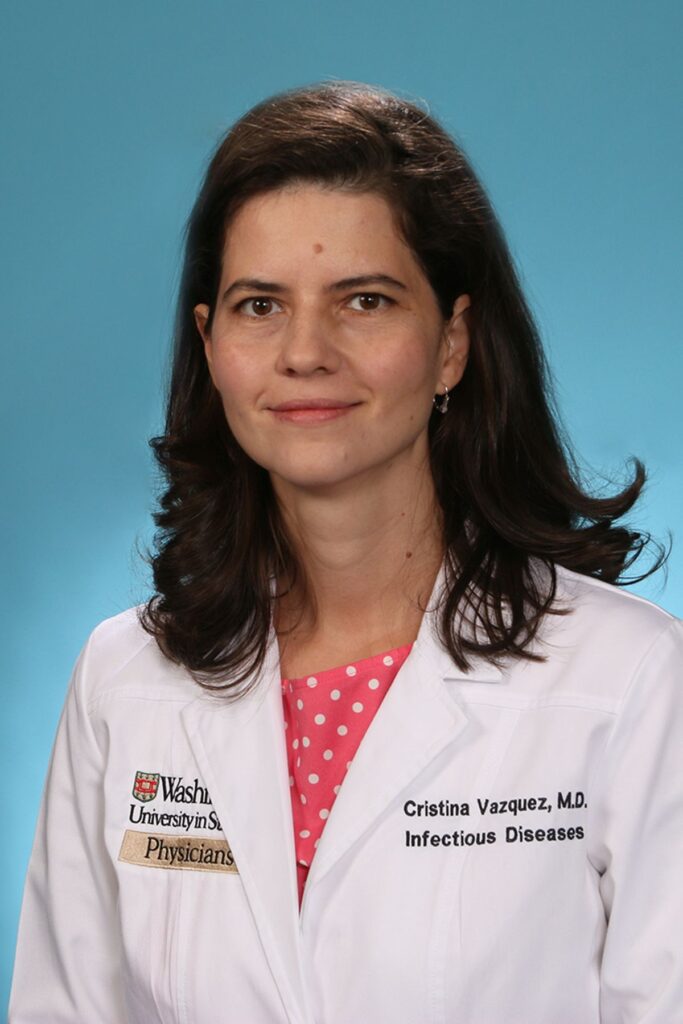
WashU Medicine Division of Infectious Diseases proudly congratulates M. Cristina Vazquez Guillamet, MD, Associate Professor of Medicine, on receiving her first NIH R01 grant. The five-year award will support her research project, “Graph Neural Networks and Longitudinal Mediation Analysis for Hospital-Onset Sepsis to Improve Early Detection and Uncover Modifiable Risk Factors.” A Research Project (R01) grant is the NIH’s flagship award supporting independent, investigator-initiated research.
Sepsis is responsible for over a quarter-million deaths in the United States each year, with hospital-onset sepsis (HOS) accounting for 25% of the cases. Despite its higher mortality, morbidity, and associated costs compared to community-onset sepsis, HOS remains largely understudied.
Vazquez believes many of HOS cases are preventable. And while a patient may survive HOS, there are significant outcomes from such an infection besides death. According to the Centers for Disease Control and Prevention, patients who recover from sepsis potentially face long-term physical and mental symptoms, including breathlessness, difficulty moving around, fatigue, confusion, and poor concentration.
Most studies focus on non-modifiable patient factors and extrapolate results from community-onset sepsis. Vazquez’s new study takes a different tack.
“Patients receive their medical care in a complicated system, rather than in isolation.”
M. Cristina Vazquez Guillamet, MD
“Our study tries to look at modifiable risk factors, and those are far more interesting. So, besides knowing who is going to fare poorly, we want to know what we can change in the way we deliver care so patients do better,” Vazquez said. The study aims to identify both predictive and modifiable system-level factors by treating hospitals as dynamic networks shaped by patient location, healthcare personnel, and the hospital environment. “Patients receive their medical care in a complicated system, rather than in isolation,” Vazquez said.
Using detailed electronic health record data from more than 200,000 patients admitted to Barnes-Jewish Hospital from January 2022 through December 2025, the study will first validate measures of healthcare personnel exposure and nursing workload, then build graph-based machine learning models to improve prediction of hospital-onset sepsis. It will also use causal methods to estimate how nursing workload and antibiotic use affect sepsis risk directly and indirectly through hospital organization and patient connections.
The innovative project includes co-investigators in biostatistics, computer science engineering, nursing and hospital epidemiology. By collaborating with experts in clinical care, nursing, machine learning, and infection prevention, Vazquez hopes to develop data-driven strategies to reduce HOS rates and improve outcomes for hospitalized patients.
The work reflects the central aim of Vazquez’s research program: translating sophisticated computational methods into practical tools that identify at-risk patients and support better bedside decision-making. Vazquez has a secondary appointment in the Division of Pulmonary & Critical Care Medicine.