Acute sinusitis leads to more antibiotic prescriptions for U.S. adults than any other condition, yet there has been no clear consensus on which antibiotic should be used for uncomplicated cases.

Findings in a recently published study shed light on two of the most commonly prescribed antibiotics and suggest that one may be preferred over the other. Anne Mobley Butler, PhD, MS, and Michael Durkin, MD, MPH — both associate professors of medicine in the Division of Infectious Diseases at WashU Medicine and associate professors of public health at WashU Public Health — co-authored a study titled, “Amoxicillin-Clavulanate vs Amoxicillin for Acute Sinusitis in Adults,” that was published on April 18, 2026 in JAMA, the peer-reviewed medical journal of the American Medical Association.
Butler and Durkin joined Timothy Savage, MD, MPH, MSc, an associate epidemiologist in the Division of Pharmacoepidemiology and Pharmacoeconomics in the Mass General Brigham Department of Medicine, and researchers from Harvard University, the Centers for Disease Control and Prevention (CDC), and the University of Washington, for this study.


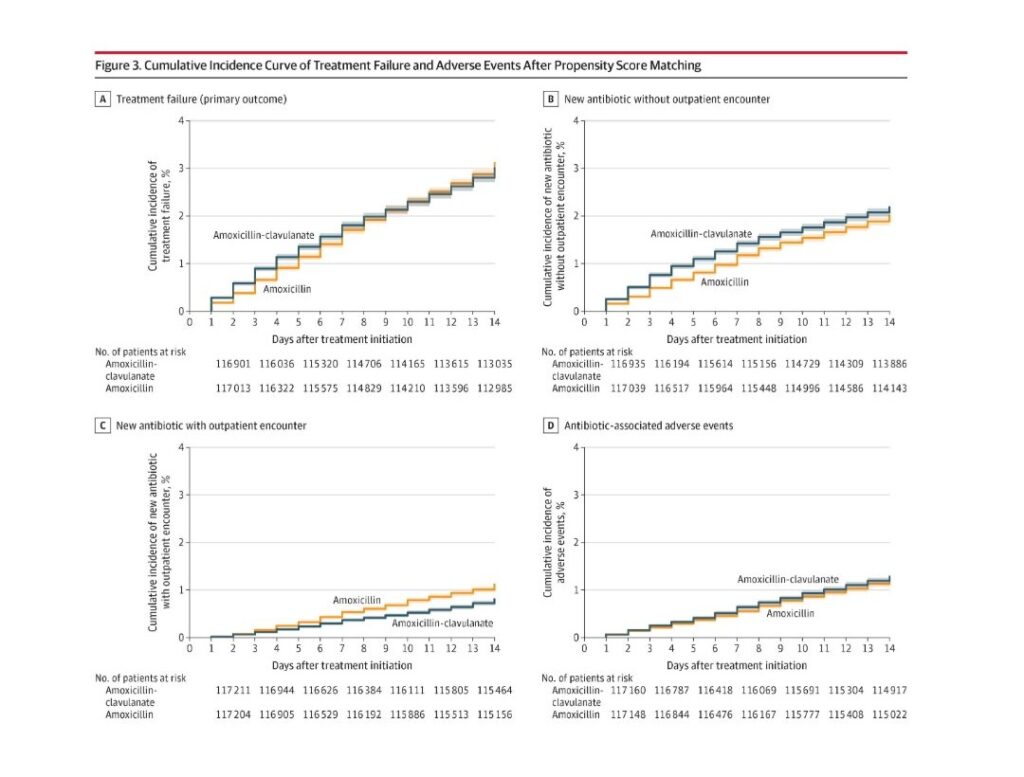
The research team compared the risk of treatment failure and adverse events between standard-dose amoxicillin-clavulanate vs standard-dose amoxicillin for acute sinusitis in adults. Clavulanate blocks an enzyme that can make bacteria resistant to amoxicillin. However, not all bacteria that cause acute sinusitis produce this enzyme, raising questions about whether the combination antibiotic offers meaningful advantages. The observational cohort study used data from insurance claims for 521,244 adults ages 18 to 64 diagnosed with a new diagnosis of acute sinusitis between January 2018 and December 2023.
Results
The study found no difference in the risk of treatment failure between the two antibiotics. The study also found no difference in antibiotic-associated adverse events associated with either treatment. However, the study found that patients who were treated with amoxicillin‑clavulanate had a small absolute increase in risk of secondary infections (including yeast infections or Clostridioides difficile infections).
Conclusions and Relevance
The researchers hope their study will encourage people to use amoxicillin for sinusitis over amoxicillin‑clavulanate — particularly due to concern for side effects. Butler says given that acute sinusitis is associated with the highest rate of antibiotic prescribing in the U.S. among adults aged 18 to 65 years, the study’s results have the potential to change antibiotic prescribing patterns and inform guideline recommendations.
“Even small increased risks from common exposures can result in substantial negative public health impact.”
Anne Mobley Butler, PhD, MS
Durkin said that while clinicians generally know that certain antibiotics have more side effects than others, “but comparing the safety or effectiveness of antibiotic regimens is not commonly done because the medications tend to be inexpensive and older. Durkin added that he and Butler were asked to join this study specifically because they do similar studies in adults using large administrative databases.
“Studies like this using large databases can be a fast and cost-effective way to help inform which antibiotics people should receive for common conditions.”
Michael Durkin, MD, MPH
Savage, the lead author, said that these findings have the potential to make a substantial impact on current treatment practices. “We found no observed benefit to using amoxicillin-clavulanate, which supports standard‑dose amoxicillin as the preferred choice for adults with uncomplicated acute sinusitis.” He added that preventing unnecessary exposure to a broader‑spectrum antibiotic can help reduce the potential risk of spreading antibiotic resistance.
The authors note that additional research is needed to better identify which patients truly benefit from antibiotics for acute sinusitis and which are more likely to have viral infections that can be managed with supportive care alone.
Savage TJ, Butler AM, Durkin MJ, Hicks LA, Huybrechts KF, Kronman MP, Sreedhara SK. Amoxicillin-Clavulanate vs Amoxicillin for Acute Sinusitis in Adults. JAMA 2026 April 18. doi:10.1001/jama.2025.26902