WashU Medicine infectious diseases researchers have developed a practical use of artificial intelligence to enhance patient safety, while potentially reducing costs and improving efficiency at hospitals. Abby Sung, MD, an assistant professor of medicine, and colleagues in the Division of Infectious Diseases, WashU McKelvey School of Engineering AI for Health Institute, and Barnes-Jewish Hospital (BJH) found that a large language model (LLM) can strengthen a semi-automated surveillance tool used by infection prevention. Dr. Sung, the primary investigator of the study, said the goal was to see if mandatory infection surveillance process could be made more efficient “so infection preventionists can spend their time doing more direct infection prevention activities, like education and walkthroughs.” Their findings were published in Clinical Infectious Diseases.
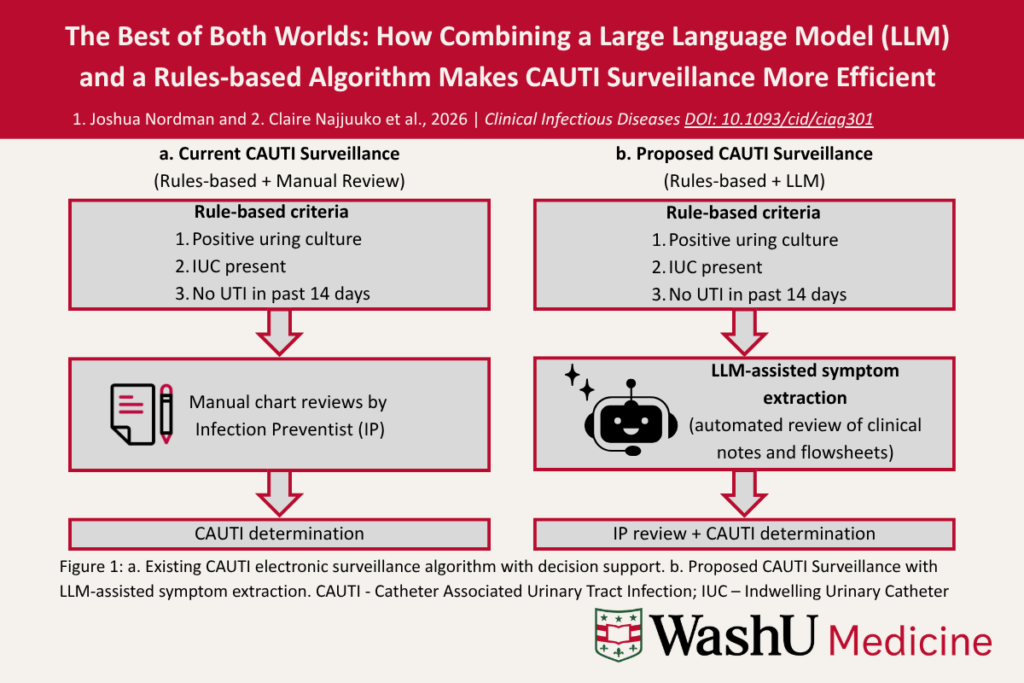
and a Rules-based Algorithm Makes CAUTI Surveillance More Efficient,” Joshua Nordman and 2. Claire Najjuuko et al., 2026 | Clinical Infectious Diseases
Focusing on further automating the standard National Healthcare Safety Network (NHSN) catheter-associated urinary tract infection (CAUTI) surveillance algorithm, the team evaluated whether using an LLM to review clinical notes and extract symptoms could improve efficiency in detection of CAUTI cases, while maintaining high accuracy. In their study, they reviewed 919 potential cases at BJH from January 2021 to June 2024. They found that the new AI-augmented approach enhanced CAUTI detection compared to both the traditional algorithm alone and stand-alone LLM approaches.
The researchers also found that using an LLM alongside the surveillance algorithm may improve efficiency by reducing the amount of time infection preventionists spend performing manual chart reviews. The researchers suggest that further improvements could be made by optimizing the clinical information presented to the model. They also suggest that this is an appropriate use of AI in healthcare because it is not being used to diagnose a patient, but rather to review existing health data.