
A new study from the Mitreva lab sheds light on the relationship between the liver fluke Fasciola hepatica and its bacterial endosymbiont, Neorickettsia. Researchers found that while these bacteria are widely present in fluke populations across the Americas and Europe, they show low genetic diversity and strong geographic patterning. Their results suggest a complex evolutionary history shaped by both long-term inheritance from parent to offspring and occasional transmission between hosts. Their findings were published in the journal Current Research in Parasitology & Vector-Borne Diseases.
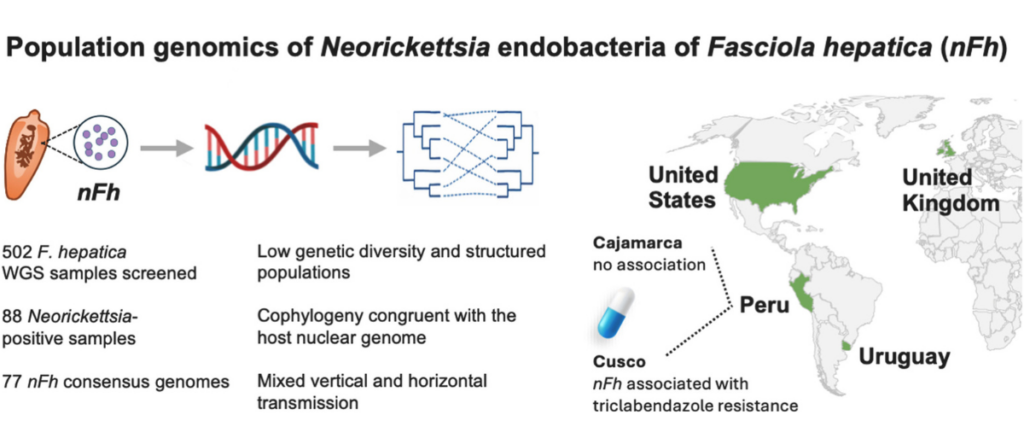
The study also points to a potential connection between Neorickettsia infection and resistance to triclabendazole, a key drug used to treat liver fluke infections. In one region of Peru, the researchers observed a strong association between bacterial infection and drug resistance, raising the possibility that the endosymbiont may influence how resistance emerges or spreads in certain settings. While the biological role of Neorickettsia is still not fully understood, these findings open new questions about how microbial partners may affect parasite biology and treatment outcomes.
Pawan Kumar, Young-Jun Choi, Martha V. Fernandez-Baca, Maria Luisa Morales, Pedro Ortiz, Cristian Hoban, Miguel M. Cabada, Makedonka Mitreva. Genetic diversity and host-symbiont cophylogenetic analysis of Neorickettsia endobacteria of Fasciola hepatica. Current Research in Parasitology & Vector-Borne Diseases. Volume 10, 2026, 100409. ISSN 2667-114X. https://doi.org/10.1016/j.crpvbd.2026.100409.
ETHICAL APPROVAL: This study involved secondary analysis of publicly available whole-genome sequencing data from the NCBI Sequence Read Archive (SRA). No new human or animal samples were collected, and no identifiable private information was used. Therefore, no ethical approval was required for this study.
FUNDING: This research was funded by the National Institute of Allergy and Infectious Diseases at the National Institutes of Health, USA (grant number 1R01AI146353). Declaration of competing interests